SEO is changing, but perhaps not in the way many marketers think.
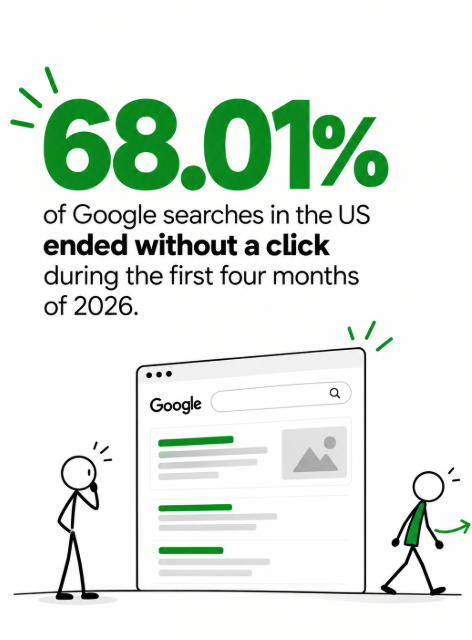
68.01% of Google searches in the US ended without a click during the first four months of 2026.
That number comes from SparkToro’s analysis of Similarweb clickstream data. For context, the figure was 60.45% in 2024. In just two years, the share of searches ending without a click has increased substantially.
At the same time, Google says AI Overviews now have more than 2.5 billion monthly active users, while AI Mode has surpassed 1 billion monthly users globally.
And there is another interesting shift.
Google says the average query in AI Mode is now three times longer than a traditional Google Search query, while people are increasingly using questions, voice and images to search.
So, naturally, marketers are asking:
Does keyword research still matter?
If Google can understand context, intent, entities, questions and entire conversations, do we still need to spend hours researching keywords?
My answer is:
Yes. But keyword research is no longer what many people think it is.
Keyword research isn’t dead.
Keyword stuffing is.
The difference is important.
Today, keyword research should help you understand your audience, their problems, their language and their intent.
It should not simply give you a list of phrases to insert into a 2,000-word article.
And that distinction is becoming increasingly important as SEO, AEO and GEO begin to overlap.
Table of Contents
The SEO industry has been asking the wrong question
For years, the standard SEO workflow looked something like this:
Find a keyword.
Check its search volume.
Check keyword difficulty.
Look at the competition.
Create a page around it.
Put the keyword in the title.
Put it in the H1.
Use it in the first paragraph.
Add variations throughout the article.
Build some links.
Wait for rankings.
There was nothing inherently wrong with keyword research.
The problem was what we started doing with the data.
Keywords became targets rather than signals.
We started asking:
“How do I rank for this keyword?”
Instead of:
“Why is someone searching for this?”
That shift might sound subtle.
It isn’t.
It changes the entire content strategy.
A keyword is a signal, not a strategy
Let’s take a simple example.
Someone searches:
“speech therapy for 3 year old”
The keyword tells you something.
But it doesn’t tell you everything.
Maybe the parent wants to know whether speech therapy is necessary.
Maybe they are worried because their child isn’t speaking yet.
Maybe they want to know what happens during therapy.
Maybe they are looking for a therapist nearby.
Maybe they are comparing speech therapy with other interventions.
Maybe they are ready to book an appointment.
The same basic keyword can sit behind very different motivations.
This is why search intent matters.
A good SEO strategy doesn’t just ask:
What are people searching for?
It asks:
What are people trying to accomplish when they search?
That is the real evolution of keyword research.
Search intent should come before content creation
Search intent generally falls into a few broad categories.
1. Informational intent
The user wants to understand something.
Examples:
- What is SEO?
- What is occupational therapy?
- How does Google Ads work?
- What is topical authority?
The appropriate content might be a guide, explainer or educational article.
2. Commercial investigation
The user is considering their options.
Examples:
- Best SEO agency for small businesses
- SEO agency vs freelancer
- Best Freelancer in Mumbai
- Google Ads vs Meta Ads
Here, comparison pages, case studies, guides and detailed service information can be more appropriate.
3. Transactional intent
The person is closer to taking action.
Examples:
- SEO agency Mumbai
- speech therapist near me
- Google Ads management services
- digital marketing consultant Mumbai
This person may need a service page, location page or landing page rather than another generic educational article.
4. Navigational intent
The user already knows where they want to go.
Examples:
- Google Search Console
- Rightly Digital
- YouTube
- Hire a digital marketing freelancer
Trying to turn every search into a blog opportunity makes little sense.
The intent determines the page.
The SERP is your SEO research tool
Before writing an article, search the query yourself.
This sounds obvious.
Yet it is one of the most frequently skipped steps in content SEO.
Look at the first page.
What is Google showing?
Are the results mostly:
- blog posts?
- service pages?
- product pages?
- comparison articles?
- videos?
- local businesses?
- forums?
- Reddit discussions?
- research papers?
- listicles?
- tools?
The SERP is telling you what Google believes the user wants.
For example, if you search a commercial query and the entire first page is made up of service pages, creating a generic informational blog post may not be your best strategy.
The issue isn’t necessarily your keyword targeting.
You may simply be creating the wrong type of page.
But if Google understands meaning, why do keywords still matter?
Because search engines still need language.
Google’s own SEO documentation continues to recommend using the words people would use to look for your content and placing them in relevant areas such as titles and headings.
But modern search engines can understand much more than exact-match phrases.
That means you don’t need to write like this:
Best SEO Agency Mumbai | SEO Agency Mumbai | SEO Services Mumbai | SEO Company Mumbai
You can write naturally about:
- SEO strategy for businesses
- technical SEO
- content strategy
- local SEO
- keyword research
- search intent
- organic growth
- conversion optimisation
Google can understand that these concepts are related.
The objective isn’t to avoid keywords.
It is to stop treating keywords as isolated strings of text.
Topical authority is the next layer
This is where modern SEO becomes much more interesting.
Instead of asking:
“What 100 keywords can we target?”
Ask:
“What topic should our business become genuinely useful for?”
Imagine an SEO agency wants to build authority around SEO.
It could publish:
- What is SEO?
- What is keyword research?
- What is technical SEO?
- What is local SEO?
- What is link building?
That’s a start.
But a stronger strategy would build a connected knowledge ecosystem.
Keyword research
- How to do keyword research
- Search intent
- Long-tail keywords
- Keyword clustering
- Competitor keyword research
Content SEO
- Content briefs
- Topic clusters
- Internal linking
- Content refreshes
- Helpful content
Technical SEO
- Crawling
- Indexing
- Canonicals
- Redirects
- Site architecture
Local SEO
- Google Business Profile
- Local landing pages
- Reviews
- Local search intent
AI Search
- AI Overviews
- AI Mode
- AEO
- GEO
- Generative search
- Search visibility in AI
Now you’re not simply creating articles around keywords.
You’re building depth around a subject.
That’s a much stronger long-term strategy.
Helpful content isn’t the alternative to SEO
Another mistake is treating these as competing priorities.
Keyword research vs helpful content
SEO vs user experience
Search intent vs topical authority
You don’t have to choose.
The strongest strategies connect them.
Keyword research tells you what people are looking for.
Search intent tells you why.
Topical research tells you what else they need to know.
First-hand experience tells you what you can add that generic content can’t.
Helpful content brings everything together.
Google’s own guidance is very clear on this.
Its ranking systems are designed to prioritise helpful, reliable, people-first content. Google specifically asks publishers whether their content provides original information, substantial value, insightful analysis and a satisfying experience.
That last part is important.
Google isn’t asking:
“Did you use the keyword 12 times?”
It is asking whether the content actually provides value.
The rise of AI search makes this even more important
This is probably the biggest change happening in search right now.
Google says AI Overviews now reach more than 2.5 billion monthly active users, while AI Mode has crossed 1 billion monthly users.
And Google says people are asking longer and more complex questions in AI Mode.
The average AI Mode query is reportedly three times longer than a traditional Search query.
Think about what that means for content strategy.
A user might traditionally search:
“best SEO agency Mumbai”
But with AI search, the same person might ask:
“I’m a small education business in Mumbai with a limited marketing budget. Should I hire an SEO agency or freelancer, and what should I expect to pay?”
That is not one keyword.
It is a problem.
And that is where content strategy has to evolve.
AEO and GEO don’t replace SEO
There is a lot of excitement around terms like:
AEO
Answer Engine Optimisation.
GEO
Generative Engine Optimisation.
I think both are useful ways of describing the changing search environment.
But I wouldn’t treat them as completely separate from SEO.
Google’s own guidance around its generative AI features continues to point website owners towards fundamental SEO practices.
Your pages still need to be discoverable.
They still need to be crawlable and indexable.
Your content still needs to be useful.
Your website still needs good page experience.
And your content needs to offer something worth surfacing.
Google’s generative AI guidance specifically highlights the importance of unique, non-commodity content and good content organisation and page experience.
So I don’t see it as:
SEO – AEO – GEO
I see it more as:
SEO + AEO + GEO
working together.
Your content needs to be worth citing
This is where I believe a major competitive advantage is going to emerge.
AI can generate generic information extremely quickly.
That means generic information is becoming cheaper.
If I ask an AI tool:
“Give me 10 SEO tips for small businesses.”
I’ll get an answer immediately.
So why would someone visit your website?
Because you have something the generic answer doesn’t.
Maybe you have:
- original research
- customer data
- case studies
- experiments
- screenshots
- industry experience
- expert interviews
- unique frameworks
- proprietary processes
- original statistics
- real examples
- strong opinions backed by evidence
This is the difference between:
“SEO is important for businesses.”
and:
“After auditing 50 small-business websites, these were the five technical SEO issues we found most frequently.”
The second one has a reason to exist.
Google’s content guidance explicitly encourages original research, analysis, substantial value and first-hand expertise.
That is particularly relevant in an era where thousands of websites can publish a technically correct article about the same topic within minutes.
Your own Search Console data can become keyword research
Here’s something I recommend doing more often.
Stop thinking of keyword research as something you only do before creating content.
Your own website can generate new keyword research.
Google Search Console can show you the queries for which your pages are appearing.
Look for four things.
1. Unexpected queries
You may discover that Google is showing your page for topics you didn’t intentionally target.
Those can become new content opportunities.
2. High impressions but low CTR
Your page is being seen but isn’t being clicked.
Possible problems include:
- weak title
- poor search intent match
- outdated content
- stronger competitors
- unclear value proposition
3. Queries ranking around positions 5 to 20
These can be excellent optimisation opportunities.
Instead of publishing another article, improve the page you already have.
4. Multiple related queries for one page
This can reveal that Google understands your page as a broader topic.
That can be a positive signal that your content has topical relevance.
And now Google has gone one step further.
As of August 31, 2026, Google Search Console’s Generative AI performance report is available globally, showing impressions from generative AI features such as AI Overviews and AI Mode.
That’s a major development for SEO measurement.
We’re moving towards a world where simply asking:
“What’s my organic ranking?”
isn’t enough.
We need to ask:
“Where is my brand appearing across the search journey?”
What should an SEO strategy look like in 2026?
If I were building an SEO strategy today, I’d use this process.
Step 1: Start with the business
Before opening Ahrefs, Semrush, Keyword Planner or any other tool, understand the business.
Ask:
Who is the customer?
What problem are they solving?
What do they buy?
What questions does sales receive?
What objections stop people from buying?
What makes the business different?
This gives keyword research context.
Without it, you’re just collecting search queries.
Step 2: Build your keyword universe
Now do traditional keyword research.
Look for:
- primary keywords
- long-tail queries
- questions
- related searches
- competitor keywords
- commercial terms
- local terms
- comparison queries
- problem-based searches
- branded searches
But don’t treat this as a publishing calendar yet.
Treat it as audience research.
Step 3: Map keywords to search intent
Group related queries.
For example:
SEO company Mumbai
SEO services Mumbai
These could belong to one commercial topic.
Whereas:
How much does SEO cost?
SEO pricing India
How much does an SEO agency charge?
may represent a different informational/commercial topic.
This prevents you from creating multiple pages that compete with each other.
Step 4: Study the SERP
Search the query.
Study what ranks.
Then decide:
What does the user actually expect here?
This is one of the simplest ways to improve content strategy.
Step 5: Build topic clusters
Create a central page.
Then build supporting pages around the subject.
Connect them with relevant internal links.
Don’t publish 50 disconnected articles.
Build a knowledge structure.
Step 6: Add something only you can add
Ask:
“What can we say that the other results cannot?”
That’s your competitive advantage.
Step 7: Optimise the page
Now use your traditional SEO fundamentals.
Optimise:
- title
- H1
- headings
- URL
- internal links
- anchor text
- metadata
- images
- structured data where appropriate
- technical accessibility
- page experience
The fundamentals still matter.
They just shouldn’t be the entire strategy.
Step 8: Measure and improve
Publish.
Measure.
Learn.
Update.
Repeat.
SEO shouldn’t be:
Publishb, rank and forget.
Your search data is feedback.
Use it.
So, what matters most: keywords, topical authority, intent or helpful content?
If you forced me to rank them, I’d say:
1. Search intent
Because if you misunderstand the reason behind the search, everything else becomes harder.
2. Helpful, genuinely useful content
Because getting someone to your page is pointless if you don’t solve their problem.
3. First-hand experience and originality
Because generic information is increasingly easy to produce.
4. Topical depth
Because being useful across an entire subject is stronger than publishing isolated articles.
5. Keyword research
Because you still need to understand how your audience expresses its needs.
6. Technical SEO
Because great content can’t perform properly if search engines can’t access or understand your website.
7. Internal linking and information architecture
Because good websites need relationships between their pages, not just individual pages.
But here’s the important part:
These aren’t competing priorities.
They form a system.
Keyword research helps you understand the market.
Search intent helps you understand the user.
Content solves the user’s problem.
Experience makes that content distinctive.
Topical depth builds broader relevance.
Technical SEO makes everything accessible.
Internal linking connects the knowledge.
Conversion optimisation turns visibility into business.
That’s SEO.
The future of keyword research isn’t fewer keywords
It’s better questions.
I don’t think we’re moving from:
“Keyword SEO”
to:
“No-keyword SEO.”
We’re moving from keyword targeting to query understanding.
From:
“What keyword should I rank for?”
to:
“What does my customer actually need?”
From:
“How many times should I mention the keyword?”
to:
“Have I actually answered the question?”
From:
“How many articles should we publish this month?”
to:
“What topics should our brand genuinely become known for?”
And perhaps most importantly:
From:
“How do I optimise this page for Google?”
to:
“Would this page still be useful if Google disappeared tomorrow?”
That last question is probably one of the best tests of content quality.
If the answer is yes, you’re probably creating something valuable.
And valuable content is where SEO, AEO and GEO increasingly meet.
Final takeaway
Keyword research is still the foundation of SEO.
But the definition of keyword research needs to evolve.
It’s no longer just about finding high-volume phrases.
It’s about understanding your audience’s language, questions, problems, intent and decision-making process.
Use keywords to understand demand.
Use search intent to understand the person.
Use topical research to understand the subject.
Use first-hand experience to differentiate.
Use helpful content to solve the problem.
And use SEO to make sure the right people, search engines and AI systems can discover and understand what you’ve created.
The goal isn’t to write for a keyword.
The goal is to become the best answer to the problem behind the keyword.
That’s the SEO strategy I’d bet on in 2026.
And that’s the approach we take at Rightly Digital.

Odell Dias is the founder of RightlyDigital.com where Online Marketing concepts are made easy. He has over 10 years of experience in the Digital Marketing industry, helping brands and individuals alike to achieve their marketing goals. He is known as one of the best digital marketing freelancers for small-to-medium-sized businesses.