If you run Google Ads, competitor research can be surprisingly difficult.
Unlike Meta, where the Ads Library makes it easy to search for ads and brands, Google’s Ads Transparency Center is primarily designed around searching for an advertiser or website. Google currently allows you to search for active ads by advertiser name or website and filter results by factors such as platform, region and date. (Google Ad Transparency)
But there’s another useful way to investigate what your competitors are advertising.
And it starts with finding just one of their ads.
Table of Contents
How to See More Ads From a Google Ads Competitor
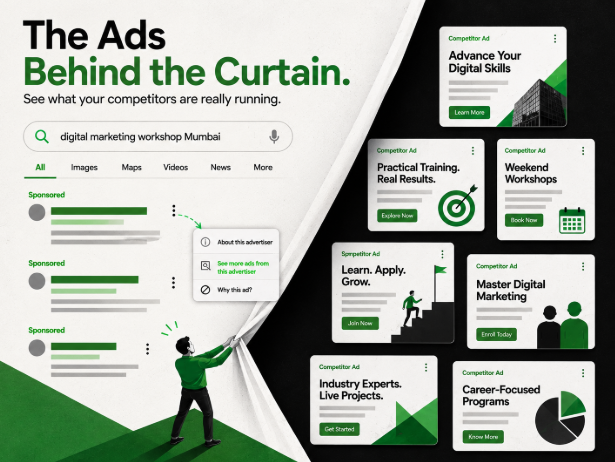
Let’s say you’re searching Google for a service or product and you notice a competitor running a Search ad.
You can use Google’s ad disclosure tools to learn more about the advertiser.
Here’s the process:
- Find the competitor’s ad on Google Search.
- Click the three-dot menu next to the ad.
- Select “About this advertiser.”
- From there, explore the advertiser information and available ad transparency options.
Google’s My Ad Center provides information about advertisers directly from ads, while the Ads Transparency Center lets you search for an advertiser or website and explore the ads associated with them. (Google Support)


This gives you a much better starting point for competitor research than simply Googling the same keyword repeatedly and hoping you see the same advertiser.
What Should You Look for in Competitors’ Google Ads?
The goal isn’t to copy your competitor.
The goal is to understand what they’re doing repeatedly.
Here are some of the things I would analyse:
1. Offers
What exactly are they offering?
Is it:
- A discount?
- A free consultation?
- A workshop?
- A limited-time offer?
- A free trial?
- A downloadable resource?
- An introductory price?
Your competitor’s offer can tell you a lot about how they’re trying to reduce friction and generate conversions.
2. Headlines and Messaging
Look at the language they’re using.
Are they focusing on:
- Price?
- Results?
- Experience?
- Location?
- Speed?
- Quality?
- Expertise?
- A specific customer problem?
You may notice that several competitors are all using the same messaging.
That’s an opportunity.
3. Calls to Action
Look at the CTAs they’re pushing.
For example:
Book Now
Enquire Today
Register Now
Get Started
Apply Today
Learn More
The CTA can reveal what action the advertiser ultimately wants the searcher to take.
4. Positioning
This is one of the most important things to analyse.
Ask:
Why would someone choose this advertiser instead of another one?
Maybe they’re positioning themselves as:
- The most affordable
- The premium option
- The local expert
- The fastest option
- The most experienced
- The specialist in a particular niche
Understanding positioning is far more useful than simply collecting screenshots of ads.
5. Landing Pages
Don’t stop at the ad.
Click through and analyse the landing page.
Look at:
- The headline
- The offer
- The form
- Social proof
- Testimonials
- Pricing
- Trust signals
- FAQs
- CTAs
- Page structure
Your competitor’s ad might be good, but their landing page could reveal even more about their strategy.
What If You Don’t Know Who Your Competitors Are?
This is where good old-fashioned Google searching still helps.
Think about what your potential customers would actually type into Google.
For example, if you’re researching the workshop market in Mumbai, you could search:
“workshops in Mumbai”
“digital marketing workshop Mumbai”
“photography workshop Mumbai”
“weekend workshops Mumbai”
“professional workshops Mumbai”
Don’t just search once.
Search multiple variations and make a note of the advertisers that repeatedly appear.
You can then investigate those advertisers through Google’s transparency tools.
Don’t Just Copy Your Competitors
This is where competitor research often goes wrong.
Someone finds a competitor running a successful-looking ad and thinks:
“Let’s make something similar.”
That’s not really competitor research.
Instead, look for patterns.
Ask yourself:
What are they offering?
What angle are they using?
What problem are they addressing?
What promise are they making?
What CTA are they pushing?
And perhaps the most interesting question:
What are they NOT saying?
That’s where the real opportunity can be.
If every competitor is talking about price, perhaps you can focus on expertise.
If everyone is talking about features, perhaps you can focus on outcomes.
If everyone is using the same generic CTA, perhaps you can make your next step clearer.
The objective isn’t to become a better copycat.
It’s to understand the market well enough to find a better angle.
Google Ads Competitor Research Is About Patterns
You don’t need to know exactly how much your competitors are spending.
You don’t need to replicate every headline they use.
And you certainly shouldn’t assume that an ad appearing on Google means it’s necessarily profitable.
What you can learn is how competitors are positioning themselves, what offers they’re promoting, what messaging they’re testing and what kind of customer journey they’re building.
That information can make your own Google Ads strategy much stronger.
For marketers, founders and business owners, competitor research should be part of the planning process—not something you do only after your campaign starts underperforming.
Need Help With Google Ads?
Running Google Ads isn’t just about choosing keywords and turning on a campaign.
The real work is in the strategy, targeting, messaging, landing pages, tracking and continuous optimisation.
If you’re looking for a Google Ads Freelancer to help set up, manage or optimise your campaigns, I’d be happy to help.
Send me a WhatsApp and let’s talk about your Google Ads campaign.
Rightly Digital – Your Freelance Digital Marketer

Odell Dias is the founder of RightlyDigital.com where Online Marketing concepts are made easy. He has over 10 years of experience in the Digital Marketing industry, helping brands and individuals alike to achieve their marketing goals. He is known as one of the best digital marketing freelancers for small-to-medium-sized businesses.