Google Ads isn’t dead.
But the old way of doing Google Ads is changing.
For years, paid search marketing followed a fairly predictable formula: identify high-intent keywords, write compelling ads, manage bids, optimise campaigns and turn clicks into leads.
That formula is becoming harder to rely on.
Google is pushing deeper into automation and AI while consumers are changing how they discover information, businesses and services. AI search, conversational platforms, short-form video, social media and communities are all competing for attention that once belonged primarily to traditional search.
The result?
Digital marketers have fewer manual levers, more automated systems and a much more fragmented customer journey.
For businesses investing in Google Ads in 2026, the question is no longer simply:
“How do I get cheaper clicks?”
It is:
“How do I build a marketing system that continues to generate demand when search behaviour and advertising platforms keep changing?”
Table of Contents
What is changing in Google Ads in 2026?
One of the biggest changes in paid search is the increasing role of automation.
Google has been moving advertisers toward automated bidding, Performance Max and AI-powered campaign features. This can make campaign execution easier, but it also means marketers have less direct control over individual elements of campaign delivery.
That creates a strange trade-off.
Campaign management becomes easier.
Understanding why the campaign is behaving a certain way can become harder.
And that distinction matters.
When impressions decline, lead quality changes or costs suddenly increase, marketers need to understand what is happening beneath the surface rather than simply accepting the recommendations presented inside the platform.
Automation isn’t necessarily the problem.
Blind dependence on automation is.
Is Google Ads lead quality getting worse?
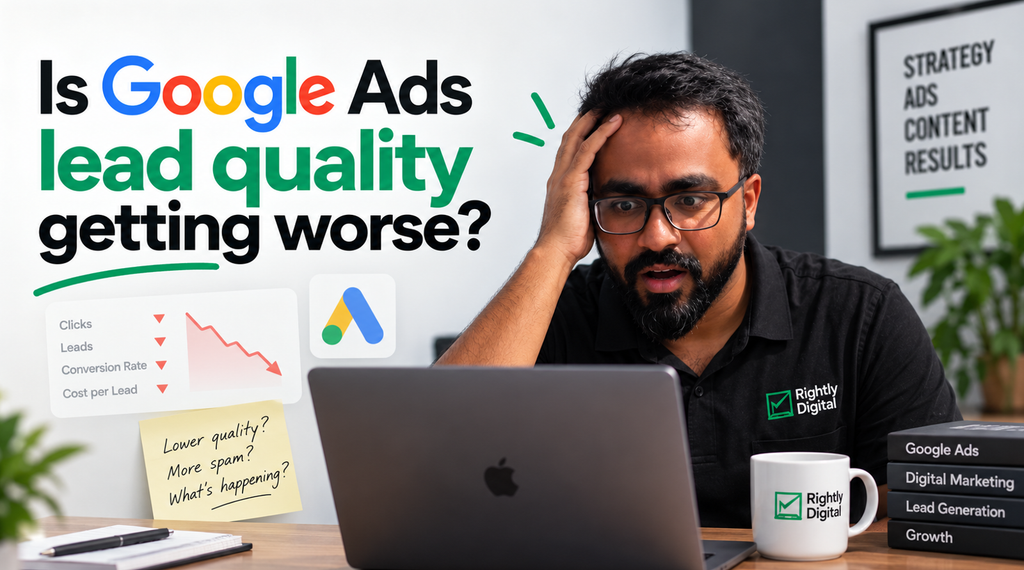
This is one of the biggest concerns marketers have about paid search today.
Businesses don’t make money from clicks.
They make money from qualified customers.
A campaign can generate 500 leads and still be a disaster if those leads don’t answer calls, book appointments, purchase products or become paying customers.
This is why measuring only platform-level metrics such as:
- Click-through rate
- Cost per click
- Impressions
- Cost per lead
- Conversion rate
is no longer enough.
Businesses should increasingly connect advertising data with actual commercial outcomes.
That creates a much clearer picture of advertising performance.
A cheap lead isn’t necessarily a good lead.
A more expensive lead that turns into a high-value customer may be considerably more valuable.
Local Services Ads are also evolving
Local businesses have another reason to pay attention.
Google is changing how Local Services Ads fit into its advertising ecosystem, with Local Services Ads transitioning toward specialised Performance Max campaigns in selected markets and categories.
This is important because Local Services Ads have historically operated differently from traditional search campaigns.
Changes to bidding, budgets, reporting and campaign structure can affect how businesses interpret performance.
That means marketers shouldn’t automatically assume that a sudden performance change is simply an account optimisation problem.
The first question should be:
“What changed?”
Was the account migrated?
Did the budget structure change?
Did bidding change?
Did targeting change?
Did service areas change?
Did reporting change?
Did the definition of a useful conversion change?
Only after answering those questions should optimisation begin.
Google isn’t the only place people search anymore
This may actually be the bigger story.
Search behaviour is fragmenting.
Someone looking for a marketing strategy might search Google.
Another person might ask ChatGPT.
Someone else might search YouTube.
Someone else might discover an agency through LinkedIn.
Another person might see a Reel, visit the website later and convert through a branded Google search.
The final Google search may receive the attribution.
But Google wasn’t necessarily where the journey began.
This is where traditional attribution models can become misleading.
The customer journey is becoming less linear.
Discovery can happen on social media.
Research can happen through AI.
Validation can happen through reviews.
A purchase can happen after a Google search.
The last click doesn’t always tell the whole story.
AI search is changing the role of SEO
Traditional SEO focused heavily on ranking web pages for keywords.
That still matters.
But AI-driven discovery introduces another layer.
People increasingly expect search systems to understand questions, compare options and provide direct answers.
This creates opportunities for strategies such as Answer Engine Optimisation (AEO) and Generative Engine Optimisation (GEO).
The objective isn’t simply to rank a page.
It’s to make your brand, expertise and content easy for search engines and AI systems to understand, retrieve and reference.
That requires more than stuffing keywords into blog posts.
It means creating genuinely useful content.
It means answering specific questions.
It means building topical authority.
It means making your organisation’s expertise clear.
And it means creating content in formats that match how people actually consume information.
Short-form video is becoming part of search strategy
Search isn’t only text anymore.
People discover businesses through videos every day.
Instagram Reels.
YouTube Shorts.
TikTok.
LinkedIn video.
Short-form content can introduce a brand before someone has developed traditional search intent.
That’s important because advertising typically captures existing demand.
Content can help create demand.
Imagine someone doesn’t know they need your service.
They aren’t searching for your service.
Google Ads can’t capture a search that doesn’t happen.
But a useful video can introduce the problem, demonstrate expertise and create curiosity.
That person may later search for your brand.
Or visit your website.
Or follow you.
Or save the content.
Or recommend you to someone else.
The customer journey can start long before the Google search.
Does this mean Google Ads is becoming irrelevant?
No.
Google still captures enormous amounts of high-intent behaviour.
Someone searching for “digital marketing agency near me” is behaving very differently from someone casually watching a marketing Reel.
Search intent remains extremely valuable.
The issue is relying on search as the entire marketing strategy.
Google Ads can capture demand.
It shouldn’t necessarily be responsible for creating all of it.
That’s the distinction marketers need to understand.
The agency model is changing too
There is a legitimate question about what happens to digital marketing agencies as advertising platforms automate more of the tactical work.
If software can automatically adjust bids, expand targeting, generate variations and provide recommendations, what exactly is the marketer being paid for?
The answer is increasingly strategy.
Campaign management is becoming more automated.
But strategy doesn’t disappear.
Someone still needs to determine:
Who should we target?
What problem are we solving?
What offer should we make?
Which audience is commercially valuable?
What creative should we use?
What happens after someone clicks?
Which leads are actually qualified?
Where else should we acquire customers?
How should the data be interpreted?
What should we stop doing?
And perhaps the most important question:
“What happens if this platform changes tomorrow?”
That is where a modern digital marketing agency can create value.
The biggest risk isn’t Google Ads. It’s platform dependency.
Imagine that 90% of your leads come from one advertising platform.
Everything looks great.
Until it doesn’t.
Your CPC increases.
Your impressions decline.
Your targeting changes.
Your competitors enter the auction.
Your audience behaviour shifts.
An algorithm update happens.
A new AI search experience changes the SERP.
Suddenly, the business has a marketing problem.
Not because Google Ads stopped working.
Because the business built its entire acquisition system around one platform.
That’s platform dependency.
And it is one of the biggest risks businesses should be thinking about in 2026.
What should businesses do differently?
The answer isn’t to immediately turn off Google Ads.
It’s to build a broader acquisition ecosystem.
1. Keep Google Ads, but measure revenue
Don’t stop at leads.
Track qualified leads, appointments, customers and revenue wherever possible.
Your advertising dashboard should eventually connect to your business dashboard.
2. Improve your website before increasing your budget
More traffic doesn’t fix a weak conversion system.
Review your landing pages, offers, messaging, forms, calls to action, trust signals and follow-up process.
3. Invest in SEO and AI visibility
Create content that answers the questions your customers are actually asking.
Build topical authority instead of publishing generic articles simply to hit a keyword count.
4. Build short-form video
Video can introduce your brand to people before they have strong search intent.
Educational content, demonstrations, FAQs, customer stories and expert-led videos can all contribute to discovery.
5. Build an owned audience
Email lists, WhatsApp communities, newsletters and customer databases give businesses something they don’t get from advertising platforms:
A direct relationship with their audience.
6. Diversify acquisition
Google shouldn’t necessarily be the only source of demand.
Depending on the business, the mix could include:
SEO, Google Ads, Meta Ads, LinkedIn, YouTube, short-form video, email, WhatsApp, content marketing, partnerships, communities and AI discovery.
The exact mix depends on the audience and business model.
There is no universal channel recipe.
What does this mean for digital marketers?
The digital marketer of the future probably won’t be judged simply by how well they manage an advertising dashboard.
They’ll be judged by how well they understand the entire customer journey.
From discovery to consideration.
From consideration to conversion.
From conversion to retention.
And from one channel to another.
Google is becoming more automated.
AI is changing discovery.
Social platforms are becoming search engines.
Search engines are becoming answer engines.
Video is becoming a discovery layer.
And consumers are becoming increasingly comfortable moving between all of them.
The smartest response isn’t to predict which platform will “win.”
It’s to stop building marketing strategies that depend entirely on any single platform.
Because platforms change.
Algorithms change.
Consumer behaviour changes.
Your marketing strategy needs to change too.
The future of digital marketing is bigger than Google Ads
Google Ads will continue to have a place in the marketing mix.
But the role of paid search is evolving.
The businesses that thrive won’t necessarily be the ones spending the most money on ads.
They’ll be the ones that understand how paid media, organic search, AI visibility, social content, video, conversion optimisation and owned audiences work together.
At Rightly Digital, that’s how we think about digital marketing.
Not as a collection of disconnected channels.
As an ecosystem.
Because the goal isn’t to build a Google Ads account that works today.
The goal is to build a marketing engine that can keep working when tomorrow looks completely different.

Odell Dias is the founder of RightlyDigital.com where Online Marketing concepts are made easy. He has over 10 years of experience in the Digital Marketing industry, helping brands and individuals alike to achieve their marketing goals. He is known as one of the best digital marketing freelancers for small-to-medium-sized businesses.